
401(k) Audit Deadline: How to Make Next Year Easier
Barely Survived This October’s 401(k) Audit Deadline? Let’s Make Next Year Easier
Quick answer: To make next year’s 401(k) audit easier, start right after the October 15 deadline. From October through December, review what went wrong and confirm your auditor or plan a switch. In December, contact your third-party administrator (TPA) and start a document “hit list” with one internal owner.
For many plan sponsors, the weeks before the October 15 401(k) audit deadline are the most stressful of the year. Late document requests, slow responses, and last-minute surprises turn a manageable deadline into a fire drill. Once the filing is in, it’s tempting to put the audit out of mind until next summer… Don’t.
The next few months are your window to fix what went wrong. This guide covers what to do if you won’t make October 15, how to tell whether it’s time to switch auditors, and a simple plan, including a document “hit list,” to make next year’s 401(k) audit run smoothly.
Didn’t make October 15? Act now.
October 15 is the final extended deadline for calendar-year plans. There is no second extension, and a Form 5500 filed without its audit report counts as incomplete, which is treated the same as late.
Late filings can draw penalties from two agencies at once:
| Agency | Penalty | Cap |
|---|---|---|
| Department of Labor | Up to $2,739 per day (unchanged for 2026) | None |
| IRS | $250 per day | $150,000 per plan year |
Once the extended deadline passes, penalties run back to the original due date.
The fix: DFVCP. The DOL’s Delinquent Filer Voluntary Compliance Program cuts the penalty to $10 per day, capped at $750 per filing for small plans and $2,000 for large plans. If you’re catching up on more than one late year, a per-plan cap applies instead: $1,500 for small plans and $4,000 for large plans. You only qualify if you file before the DOL notifies you in writing, so finish the audit and file as soon as you can.
If your audit is still open, talk with your auditor today about a realistic completion date.
Is it time to switch 401(k) auditors?
Missed deadlines, unanswered emails, surprise fees, a different staff member every year: if that sounds like your audit this year, you’re not alone. Many plan sponsors stay with a frustrating auditor because switching feels risky. In practice, it’s simpler than most sponsors expect, and right after audit season is the best time to do it.
Why switch auditors now?
- The pain is fresh. You know exactly what went wrong and what you want to change.
- Next year isn’t booked yet. Most auditors schedule the coming season over the winter, so switching now avoids a rushed transition next summer.
- The handoff is simple. Your new auditor reviews this year’s report and coordinates directly with your TPA, so you don’t start from scratch.
What should a good 401(k) audit feel like?
- A clear request list up front, so you aren’t chasing surprise requests in October
- Responsive, consistent people who know your plan year after year
- Practical recommendations that help you run a cleaner plan, not just a report
- Transparent fees agreed before the work begins
For a fuller checklist, the DOL’s guide to selecting an auditor for your employee benefit plan covers what to ask about licensing, peer review and plan audit experience.
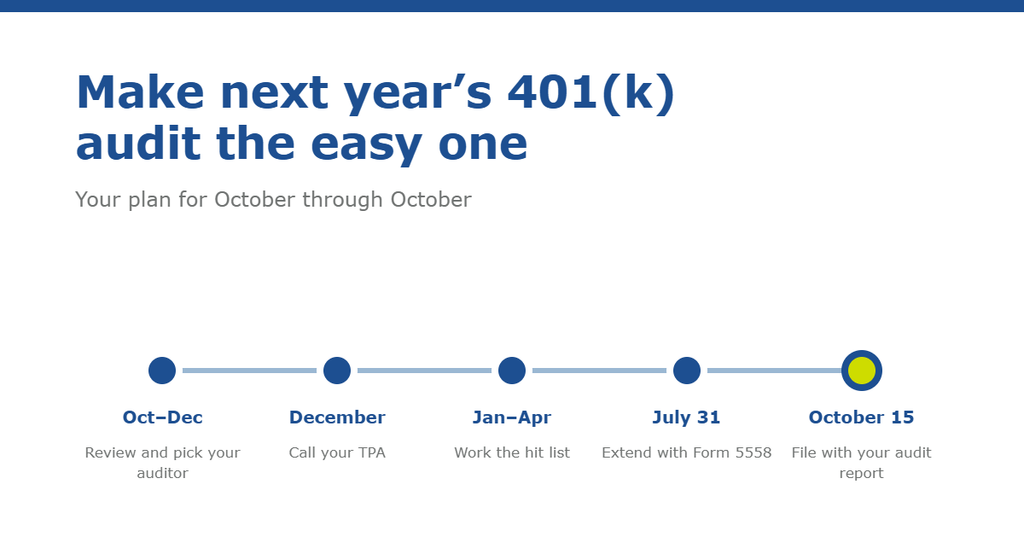
How to make next year’s 401(k) audit easier
For a calendar-year plan, here’s a simple timeline:
| When | What to do |
|---|---|
| October–December | Review what went wrong this year; choose or confirm your auditor and sign the engagement letter |
| December | Contact your third-party administrator (TPA); confirm participant count and whether an audit is required |
| December 31 | Plan year ends |
| January–April | Gather year-end data; work through your hit list |
| Spring–early summer | Auditor follow-up questions |
| July 31 | Original Form 5500 due date; file Form 5558 by this date if you need the extension |
| October 15 | Final extended deadline |
Step 1: Contact your third-party administrator (TPA) early
Your TPA holds much of the data your auditor needs. Reach out to your TPA this winter and agree on dates. Once January comes, request that year-end data.
Ask your TPA to:
- Confirm your participant count and whether an audit is required
- Provide the year-end census, compliance testing results (ADP/ACP and top-heavy) and any corrective distributions
- Release recordkeeper reports, including the trust statement and, if applicable, the investment certification
- Share its SOC 1 report, which auditors use to understand your service provider’s controls
- Agree on who prepares the Form 5500 and when the audit report must be ready
Step 2: Create a 401(k) audit “hit list”
A hit list is a single checklist of every document and open item, with an owner and due date for each. Start it before the plan year closes and your team, your TPA and your auditor will all work from the same page.
Plan documents
- Plan document, adoption agreement and all amendments
- Summary plan description (SPD)
- Most recent IRS determination or opinion letter
- Prior-year Form 5500 and audited financial statements
Financial and investment records
- Year-end trust or custodial statements
- Investment certification, if electing a 103(a)(3)(C) audit
- Contribution, distribution and loan reports from the recordkeeper
- Fidelity bond and fiduciary insurance policies
Payroll and participant records
- Payroll registers and the year-end payroll summary
- Deferral remittance dates, to confirm timely deposits
- Personnel files for the participants the auditor selects (enrollment forms, deferral elections, hire and termination dates)
- Distribution and loan paperwork for selected participants
Compliance and governance
- Nondiscrimination and top-heavy testing results
- Investment or retirement committee meeting minutes
- Service provider fee disclosures (408(b)(2))
- Documentation of any known errors and corrections
Tip: Assign one internal point person to own the hit list, and save this year’s list as next year’s starting point. Auditors move fastest when requests go to one place.
Will your plan need an audit next year?
A 401(k) audit is an independent review of your plan’s financial statements, operations and compliance by a qualified CPA firm. ERISA requires it for “large plans,” and the report is filed with Form 5500.
Your plan generally needs an audit if it has 100 or more participants with account balances at the start of the plan year. Since 2023, the count includes only participants with balances, not every eligible employee. If your plan is growing, check your count early so an audit requirement doesn’t catch you by surprise.
The 80–120 rule. If your plan has between 80 and 120 participants at the start of the year, you may be able to keep filing as a small plan, and skip the audit, if you filed as a small plan the prior year.
Types of 401(k) audits
- ERISA Section 103(a)(3)(C) audit: the auditor relies on investment information certified by a qualified bank or insurance carrier.
- Non-103(a)(3)(C) audit: the auditor also tests the plan’s investments directly.
Either way, auditors test contributions, distributions, loans, eligibility, the plan’s definition of compensation and timely deposit of employee deferrals.
Ready for a better 401(k) audit next year? Switch to Lucida Tax + Accounting Solutions
You made it through October 15. Next year, the deadline shouldn’t be the hardest part of your plan year. A well-planned audit with a responsive team turns audit season into a routine checkpoint, and switching auditors is simpler than most plan sponsors expect.
Lucida is one of the largest full-service accounting firms in Wisconsin, with over 100 dedicated professionals and 30 years of experience providing accounting, advisory, audit, payroll and tax services. Our audit team helps plan sponsors turn the 401(k) audit from an annual scramble into a predictable, well-planned process.
How Lucida makes your 401(k) audit easier
- A smooth transition. With your permission, we coordinate with your prior auditor and your TPA, so switching doesn’t mean starting over.
- A clear request list. You’ll know what we need, who it comes from and when it’s due, built around the hit list above.
- A consistent team. The same people work on your plan year after year, so you aren’t re-explaining it every summer.
- Early scheduling. We plan well ahead of the July 31 and October 15 deadlines.
- Transparent fees. We agree on fees before the work begins, so there are no surprises.
- Practical recommendations. Beyond the audit report, we share observations that help you run a cleaner plan.
If this year’s audit left you frustrated, let’s talk now, before next season is scheduled. Contact Lucida’s Audit Team to learn how we can make your next 401(k) audit easier.
Get in Touch →401(k) audit FAQs
When is the 401(k) audit deadline?
For calendar-year plans, the Form 5500 and its attached audit report are due July 31. Filing Form 5558 by July 31 extends the deadline to October 15. For other plan years, the original due date is the last day of the seventh month after the plan year ends.
What is a TPA in a 401(k) audit?
A TPA, or third-party administrator, is the outside firm that handles your plan’s day-to-day administration, such as recordkeeping, compliance testing and often Form 5500 preparation. Your auditor relies on the TPA’s reports and its SOC 1 report, so involving your TPA early speeds up the audit.
Can I switch 401(k) auditors, and when is the best time?
Yes. The best time is right after audit season, from October through December, before next year’s work is scheduled. Your new auditor reviews the prior year’s audit and coordinates directly with your TPA, so the transition is manageable and you avoid a rushed handoff next summer.
How can I make my 401(k) audit go faster?
Contact your TPA this winter and build a hit list with one internal owner. At Lucida, most 401(k) audits take 6–8 weeks from the start to the final report.
How many participants trigger a 401(k) audit?
Generally, 100 or more participants with account balances at the start of the plan year. The 80–120 rule may let some plans near that line keep filing as small plans.
What does a 401(k) auditor look for?
Accurate contributions and distributions, timely deposit of employee deferrals, correct use of the plan’s definition of compensation, eligibility, loans and proper plan operation.
What if I miss the October 15 Form 5500 deadline?
Finish the audit and file as soon as possible. The DOL’s DFVCP reduces penalties to $10 per day, with caps, for sponsors who file before the DOL contacts them.
Can I extend the October 15 deadline?
No. Form 5558 provides one 2½-month extension, and October 15 is the final extended date for calendar-year plans.
Make next year’s 401(k) audit the easy one. Lucida’s Audit Team will help you plan early, coordinate with your TPA and stay well ahead of the deadline.
Get in Touch →Sources
- U.S. Department of Labor, EBSA: Delinquent Filer Voluntary Compliance Program
- Federal Register (May 27, 2026): DOL notice of no civil penalty inflation adjustment for 2026
- Internal Revenue Code: 26 U.S.C. § 6652(e), penalty for late Form 5500 filings
- IRS: Form 5558 reminders (Form 5500 extensions)
- U.S. Department of Labor, EBSA: Form 5500 Series
- U.S. Department of Labor, EBSA: Selecting an Auditor for Your Employee Benefit Plan (PDF)
