
Made in USA? Be Careful When Advertising
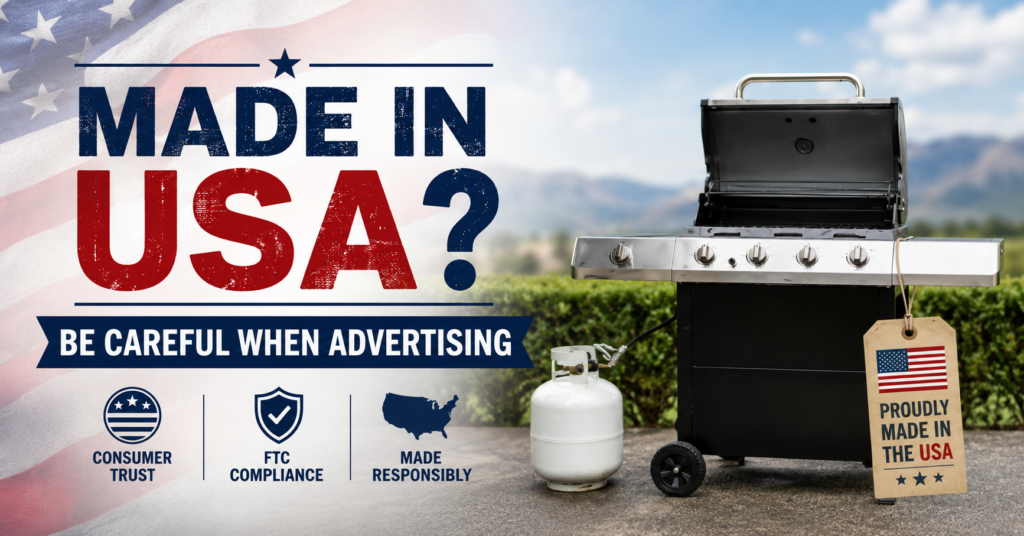
A quick quiz: Let’s say a company produces barbecue grills in its Nevada plant using components primarily made in the United States. However, the knobs and tubing are sourced from Mexico. The business nevertheless advertises its grill as Made in USA. Isit justified, or does it potentially violate Federal Trade Commission (FTC) rules?
To consider another example, let’s say a clothing company designs dresses in New York but manufactures them in Bangladesh. It advertises its clothing as Created in USA. Is this a creative solution or a problem? Let’s take a look.
Sales Advantage
In recent years, Americans have shown an increased interest in buying products made in U.S. factories by their fellow citizens. This provides significant advertising and sales advantages to businesses that actually sell products produced domestically.
However, the FTC, which is charged with preventing marketplace deception and unfairness, requires that products advertised as Made in USA be “all or virtually all” made in this country or its territories. What does that mean in reality? That “all significant parts and processing that go into the product must be of U.S. origin.” So you must consider where part originate: “The product should contain no — or negligible — foreign content” and must be made in one or more of the 50 U.S. states, District of Columbia or U.S. territories and possessions.
Quiz Answers
All of this means that in our first example, the barbecue grill business would need to assess what percentage of its parts are imported from Mexico. There’s no magic number that indicates a product is composed of “virtually all” U.S.-made parts. But because knobs and tubing are relatively small components of the total manufacturing costs and final product, the business’s Made in USA claims aren’t likely to be challenged as deceptive. However, to be extra careful, the business might want to refrain from such advertising.
In the second instance, the claim would likely be considered deceptive. According to the FTC, consumers generally interpret the term Created in USA as Made in USA. This makes it an express or implied claim. In fact, even a picture of an American flag or a U.S. map with no words in such as advertisement could convey an implied representation that a company’s product is made domestically.
When To Ask Advisors
We can help you determine total production costs and isolate the percentage of any non-U.S. parts. But if you’re concerned about potential regulatory or legal action, run your advertising claims past your legal advisor.
